1. Start with the sales channel, not the cube
A packing cubes Amazon launch has different requirements from a travel shop wall display, a hotel guest kit or a corporate gift. Amazon needs a clear main image, repeatable set content, low return risk, compact cartons and listing data that matches the product and packaging. A shop may prefer more colours and smaller reorders. A brand may need a family look across organisers, toiletry bags and luggage tags.
Before asking for a quote, define the selling format. Will you sell a set of packing cubes only, or a wider travel organiser private label range with shoe bags, laundry pouches, tech cases and toiletry bags? Will the product be a value offer, a coordinated luggage accessory range, or a giftable travel set?
At VoyagiQ we work B2B only. We import luggage and travel accessories factory-direct for European businesses, including online sellers, luggage shops, travel brands, promo agencies, hotels and distributors. Our catalogue includes 440+ products, including packing cubes and organisers, toiletry bags, vacuum bags, luggage tags, locks and other travel essentials.
2. Choose the set configuration
The specification starts with the set, not the logo. For Amazon, confusing set content causes negative reviews and returns, so each piece should have a clear purpose and be shown consistently in images, inserts and packaging.
Common options include:
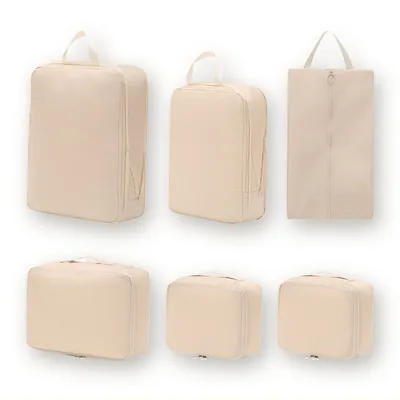
- standard packing cube sets for shirts, trousers, underwear and small accessories;
- compression packing cubes with an extra zip to reduce volume;
- mesh-top cubes for visibility and ventilation;
- opaque organisers for a cleaner retail look;
- shoe bags, laundry pouches and garment organisers;
- tech cases for cables, chargers and adapters;
- jewellery rolls and small pouches for higher-value bundles.
For private label packing cubes, do not add pieces only to make the set look larger. Extra pouches increase material, sewing time, packing labour, carton volume and listing complexity. It is usually better to build a set that customers understand quickly and that warehouse staff can check easily.
3. Specify materials and construction
Small differences in material change both cost and perceived value. Polyester is common for packing cubes because it is light, stable and available in many colours. Nylon can give a smoother hand feel but may affect price. Mesh panels reduce weight and help users identify contents. Opaque panels look more orderly in product photos and can suit hotel or corporate gifting projects.
The specification should cover:
- outer fabric and mesh type;
- lining, if any;
- zip type and zip puller design;
- binding tape width and colour;
- handle position and reinforcement;
- seam style and sewing tolerance;
- compression zip for compression versions;
- folded size and packed size;
- individual polybag, paper band, pouch or retail box.
For Amazon, handles and zips deserve attention. They are the parts customers touch first and complain about if they feel weak. Ask for close-up sample photos before the physical sample is sent. Keep an approved sample as the production reference.
4. Decide how your brand appears
Branding can be subtle or visible. A woven label on each cube is the usual starting point. Rubber patches, printed logos, metal zip pullers and custom colour combinations create a stronger brand look but increase set-up work and cost. For a travel organiser private label family, use the same logo placement across packing cubes, toiletry bags, passport wallets and tech cases.
Packaging has a large effect on Amazon and retail cost. A rigid box can look attractive but adds volume and freight cost. A printed sleeve or kraft band may be enough if the product is sold online. For shops, hang cards or shelf-ready boxes may be better. For promo and hotels, a simple branded pouch can work well.
Private label options can include your logo, packaging, EAN, multilingual labels and product inserts. See our private label travel accessories service if you need a complete range rather than one item.
5. Build the Amazon specification file
Do not rely on a marketplace-style description when briefing production. A clean specification file prevents misunderstandings and makes quotes comparable. It also supports the product listing, inspection checklist and reorder.
Your file should include:
- set content with size of each organiser;
- fabric, colour references and logo method;
- packaging type, barcode position and carton marks;
- country versions for language labels and warnings;
- main product claims and claims to avoid;
- target selling price and target landed cost;
- Amazon marketplace countries and fulfilment route;
- photo requirements for the listing.
For online listings in the EU, GPSR information must also be available. That means the product should show the responsible economic operator details, product identification and required warnings in the language of the country of sale. The same data should appear in the online listing where required. VoyagiQ acts as the EU importer when we supply the goods.
6. Understand the cost drivers
The cheapest unit price is not always the cheapest launch. Packing cubes are light, but sets can take carton space. Packaging, colour, piece count and carton size all affect landed cost. Compression cubes usually cost more than standard cubes because of extra zips, more sewing and more quality checks.
| Cost driver | Why it matters | Buyer decision |
|---|---|---|
| Set content | More pieces add material and packing labour | Sell a clear set, not a crowded set |
| Fabric and mesh | Changes feel, weight and colour options | Approve material with the sample |
| Logo method | Label, print and patch have different set-up work | Match branding to retail price |
| Packaging | Boxes increase volume and freight cost | Use only as much packaging as the channel needs |
| Inspection | Zips, sewing and set content must be checked | Use a written inspection checklist |
Our quotes use your specification and show the commercial values with placeholders on the website: private-label MOQ from 300 pieces per model, typical order-to-warehouse timing of 8–12 weeks, production time around 25–45 days and rail or sea transit to Poland around 25–45 days. Air freight is possible for urgent light shipments and samples, with timing around 7–12 days. Samples usually take 7–14 days and are credited against the order when the project proceeds.
7. Samples: test like a customer and like a warehouse
A sample is not only for colour approval. Fill each cube with clothes, pull the zip around the corners, carry it by the handle and compress it if it is a compression model. Check whether the set folds back into the pouch or retail pack without forcing. If the product will be sold on Amazon, photograph the sample in the same style you plan to use for the listing.
Also check warehouse handling. Does every piece have the correct label? Is the barcode scannable on the packed unit? Does the carton mark identify the SKU clearly? Can a warehouse worker see whether the set is complete without unpacking every item? These details reduce receiving delays and listing mistakes.
8. Compliance and labelling in the EU
Packing cubes are consumer products, so GPSR applies. The product or packaging needs the EU economic operator name, postal address and e-mail address, product identification such as type or batch, and warnings where relevant. Language requirements depend on the country of sale.
Textile fibre labelling may apply to textile products under Regulation 1007/2011. If PVC windows, coated labels or plastic parts are used, REACH can become relevant, including restrictions on phthalates in PVC and PAH in certain plastic or rubber parts with skin contact. For PU details, DMF may be relevant. We request lab tests where the material and claim require them, and we share the report if it exists for that order.
Packaging EPR is also part of the launch plan. Germany, Poland, France and other markets have separate registration and reporting systems. Amazon sellers should check both legal duties and platform fields before goods arrive.
9. Production, inspection and freight
Once the sample and artwork are approved, the order moves into production. The purchase documents should include the specification, artwork, packaging, carton details, delivery date, inspection standard and payment terms. Payment is usually by deposit with the balance before shipment. Deferred terms are normally for repeat clients with a credit limit.
Pre-shipment inspection checks quantity, workmanship, zips, seams, branding, packaging and carton marks. For set products, the inspector should verify that each unit contains the correct pieces in the correct sizes and colours. This is where a clear specification saves time.
VoyagiQ handles freight, customs and VAT in Poland and then delivery across the EU, UK, Switzerland and Norway. If you prefer not to be the importer of record, buying through an EU importer gives you an EU invoice, checked documents and a delivered B2B process.
10. Launch plan for Amazon and other B2B channels
Plan backwards from the date when the product must be in stock. Private label by sea should be ordered in the November to January window for the main summer travel season. Online sellers often reorder from February to June. Promo Christmas projects usually need decisions from August to October. Hotels and tour operators often buy from February to April.
For the listing, prepare product titles, bullet points, compliance data, images and carton data before stock arrives. Avoid claims you cannot support. Do not call a fabric recycled, waterproof, antibacterial or certified unless the documentation for that specific order supports it. For packing cubes amazon projects, plain language often works better: size, set content, compression function, handle, mesh panel, use case and care instructions.
If you need a written offer, send your target product, set content, logo, packaging idea, selling countries and estimated quantity. We usually prepare a written quotation within 2 working days. You can also start from the VoyagiQ catalogue or send a brief through request a quote.
What to send us for a faster quote
A complete brief does not need to be long. Send the product type, set pieces, approximate sizes, colour, branding method, packaging, country of sale, target date and expected order quantity. If you already have an Amazon listing draft or competitor reference, include it as a functional reference, not as something to copy.
We then check suitable manufacturer options, MOQ, indicative landed cost, samples, timeline and compliance documents. The result is a practical launch plan for private label packing cubes or a wider organiser range, with the import work handled by VoyagiQ.