1. Start with the customer and the price point
Professional buyers often ask for the strongest suitcase first. That is understandable, but it is not how the range should be built. A luggage shop, online seller, airport retailer, hotel group or promo agency needs a material that fits the use case, retail price, margin and replacement expectations.
A cabin case sold as an impulse airport purchase has a different job from a branded three-piece family set. A hotel retail corner may want conservative colours and easy replenishment. A marketplace seller may need low carton damage, clear product data and repeatable photos. A brand developing an OEM line may accept higher unit cost if the shell finish and handle feel support the brand position.
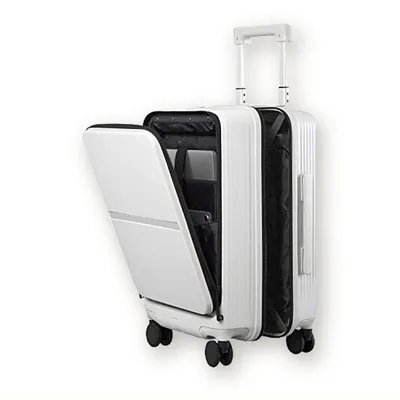
VoyagiQ supplies B2B buyers with factory-direct suitcases and travel accessories through an EU company invoice. Our suitcases and luggage sets category covers PC, PP, ABS and aluminium options, including cabin, medium and large sizes. The catalogue shows 440+ travel products across luggage and accessories, with private-label and sourcing options for models outside the catalogue.
2. Polycarbonate: flexible shell, higher perceived value
Polycarbonate, usually shortened to PC, is often chosen for mid-market and brand ranges because it combines a glossy or textured finish with good flexibility. When a loaded suitcase is hit, the shell can flex and return closer to its original shape than more brittle plastics. That does not make it indestructible, but it helps with customer perception and handling in travel retail.
For buyers comparing polycarbonate vs abs luggage, the main difference is the balance between flexibility, finish and cost. PC normally sits above ABS in price. It can support cleaner moulding, deeper colours and a more retail-ready look. It is a good choice for luggage shops, online sellers with branded listings, and retail chains that want a product line above entry level.
- Good for: branded cabin cases, luggage sets, department-store ranges and online private label.
- Watch: material thickness, corner design, wheel housing, handle wobble and colour consistency between production batches.
- Buyer tip: ask whether the shell is full PC or a PC composite, because catalogue wording can vary by supplier.
PC can be combined with textured surfaces to reduce visible scratches. High-gloss finishes photograph well, but they show marks faster in returns and showroom display. If your sales channel has many first-time luggage buyers, a textured shell may reduce complaints about cosmetic wear.
3. Polypropylene: impact-friendly and practical for volume ranges
A polypropylene suitcase, often marked as PP, is usually chosen when the buyer wants a practical hard-shell product with good impact behaviour and a slightly more utilitarian feel. PP is flexible and resistant to stress, especially in colder conditions, but it may not always have the same glossy, sharp retail appearance as PC.
PP works well for family travel, value-focused luggage shops, distributors and retail chains that need a dependable middle offer. It is also useful where the buyer wants a hard-shell suitcase that can tolerate rough handling without moving immediately into aluminium pricing.
- Good for: value-to-mid ranges, family sets, promotional travel campaigns with longer use expectations.
- Watch: surface texture, mould lines, wheel fit, zip quality and colour matching across set sizes.
- Buyer tip: compare packed carton dimensions, not only unit price, because a slightly bulkier shell can change freight cost.
PP can be less rigid in hand than ABS, which some retail customers interpret differently. In product descriptions, avoid vague claims. Explain the benefit in plain words: a flexible hard shell, designed for regular travel use, with details such as spinner wheels, telescopic handle, divider and combination lock where included.
4. ABS: entry price, light weight and broad colour choice
ABS remains common in entry and promotional luggage because it is easy to mould, usually lighter on cost and available in many colours. It helps buyers reach attractive retail prices for seasonal campaigns, online bundles and first-price luggage sets. The trade-off is that ABS is generally less flexible than PC or PP, so shell cracking risk can be higher if design, thickness or packing is poor.
ABS can still be commercially sensible. For an online seller testing a new luggage niche, a shop building a low-entry range, or a promo buyer needing a travel gift, ABS can meet the brief. The important point is not to sell it as the same proposition as PC. Position it honestly: a lightweight hard-shell option for price-sensitive travel needs.
- Good for: first-price ranges, seasonal offers, corporate travel gifts and starter luggage sets.
- Watch: corner strength, shell thickness, zip stitching, wheel brackets and carton protection.
- Buyer tip: inspect loaded movement, not only empty appearance. Fill the sample and roll it over thresholds.
ABS is also useful where a buyer wants strong colour variety for a campaign. For private label, confirm logo method, packaging artwork, EAN requirements and language labels before production starts. VoyagiQ can support private-label luggage with your logo, packaging and multilingual labels through our private label service, subject to 300 per model.
5. Aluminium: high ticket value, but a different buying logic
An aluminium case is bought for look, structure and brand position. It is heavier and more expensive than plastic-shell luggage, but it can create a strong retail story for business travel, gifting and higher-ticket ranges. For aluminium suitcase wholesale, buyers should treat the product as a separate category rather than a simple upgrade from PC.
Aluminium shows dents and scratches as part of its use pattern. Some customers like that; others complain if they expected a permanently perfect surface. Retail training and online descriptions matter. State the material, finish, closing system and internal layout clearly. If the model uses latch closures instead of a zip, show that in photos and explain it in the listing.
- Good for: brand projects, executive gifts, design-led luggage shops, airport retail and limited collections.
- Watch: corner protectors, latch alignment, frame gaps, handle fittings and packaging around edges.
- Buyer tip: order and approve a sample before committing to a full colour or logo programme.
Aluminium is not always the right choice for hotels or tour operators that need easy replacement and low complaint handling. It is better when the buyer can support a higher price and explain the character of the material.
6. Compare the materials before you request prices
A clean comparison helps your supplier quote the right product. If you only ask for “a good suitcase”, you will receive models at different material levels, wheel systems and packaging standards. Ask for the shell material, size, weight, lining, wheel type, handle type, lock type, carton size, branding method and production lead time.
| Material | Typical resale position | Main advantage | Main buying risk |
|---|---|---|---|
| Polycarbonate | Mid to upper-mid luggage ranges | Flexible shell and strong shelf appearance | Higher cost; check full PC vs composite wording |
| Polypropylene | Practical value-to-mid ranges | Good impact behaviour for regular travel use | Finish may look less glossy than PC |
| ABS | Entry price and promotional ranges | Low cost, light feel and many colours | More brittle if design or packing is weak |
| Aluminium | Design-led and high-ticket projects | Distinct look and rigid frame construction | Dents, weight and higher customer expectations |
Do not compare only the ex-factory unit price. Suitcases take space. Carton dimensions, nesting, set packing and mixed-container planning can change the delivered cost. A model that is slightly cheaper per piece may be more expensive after freight, duty handling and warehousing.
7. Specify components that cause most complaints
Many luggage complaints are not about the shell material. They are about wheels, handles, zips, locks, lining, stitching and packaging damage. For resale, these details decide whether the product becomes a repeat order or a one-season problem.
- Wheels: check spinner movement under load, wheel housing strength and noise on hard floors.
- Telescopic handle: check wobble, smooth extension and how it locks at each height.
- Zip or frame: check corners, stitching, pullers and whether the case closes easily when packed.
- Lock: use “TSA” wording only where the factory holds the licensed mechanism and it is confirmed for the order.
- Interior: check divider fabric, compression straps, pockets and lining attachment.
- Packaging: check polybag, corner protection, master carton strength and label placement.
For online sellers, also request product images, measurements and packaging data early. For retail chains, request shelf carton and barcode information. For promo agencies, confirm logo position and print area before promising the concept to the end client.
8. Samples, timing and order planning
Suitcases should be sampled because small details are difficult to judge from photos. A sample lets you check shell flex, surface finish, wheel movement, handle feel, lining and packaging. Samples usually take 7–14; for private-label samples, allow time for logo placement and packaging artwork approval.
For a standard factory-direct order, plan around 8–12 from order to our warehouse, including 25–45 for production and 25–45 for rail or sea movement to Poland. Air freight can be used for urgent samples or selected urgent goods, with 7–12 as the planning placeholder, but it is rarely economical for bulky suitcase orders.
Seasonality matters. Retail chains often plan the next summer range in autumn and confirm early in the year. Independent shops and online sellers usually reorder before and during the spring travel build-up. Private-label suitcase projects should be started early enough to approve the sample, artwork, labels and inspection criteria before production.
9. EU compliance and labelling points
Suitcases are consumer products, so the General Product Safety Regulation applies. The product or packaging needs an EU economic operator, postal and e-mail address, product identification such as type or batch, and warnings in the language of the country of sale where relevant. The same core data should be reflected in online listings.
Material rules also matter. REACH can be relevant to plastic, rubber, PU, leather and coated parts. For example, phthalates can be relevant in PVC parts, PAH in plastic or rubber skin-contact components such as handles, DMF in PU, and chromium VI in leather details. Textile fibre labelling can apply to textile components such as linings or covers. We request lab tests where the material requires it and keep the documentation linked to the order.
Packaging EPR also needs attention, including systems such as LUCID in Germany, BDO in Poland and Triman in France depending on the market. VoyagiQ acts as importer for the goods we supply and supports category-specific documentation through our quality and compliance process.
10. How VoyagiQ helps buyers choose
VoyagiQ is the travel-accessories line of EnjoyGroup Sp. z o.o., based in Poland and active since 2015. We sell B2B only. Our customers include travel accessory shops, luggage shops, airport and station retail, online sellers, brands, retail chains, promo agencies, hotels, tour operators and distributors.
For suitcase materials, our role is practical: we help you compare the model, material, components, MOQ, packaging, lead time, import cost and compliance file before you commit. You receive an EU invoice, and we handle factory-direct sourcing, quality control, freight, customs and VAT in Poland, with delivery across the EU, UK, Switzerland and Norway.
If you already know the target retail price and sales channel, send us the brief. If you are still deciding between PC, PP, ABS and aluminium, send the expected quantity, country of sale, branding needs and launch date. We will return a written offer within 2. You can start from the quote request page.